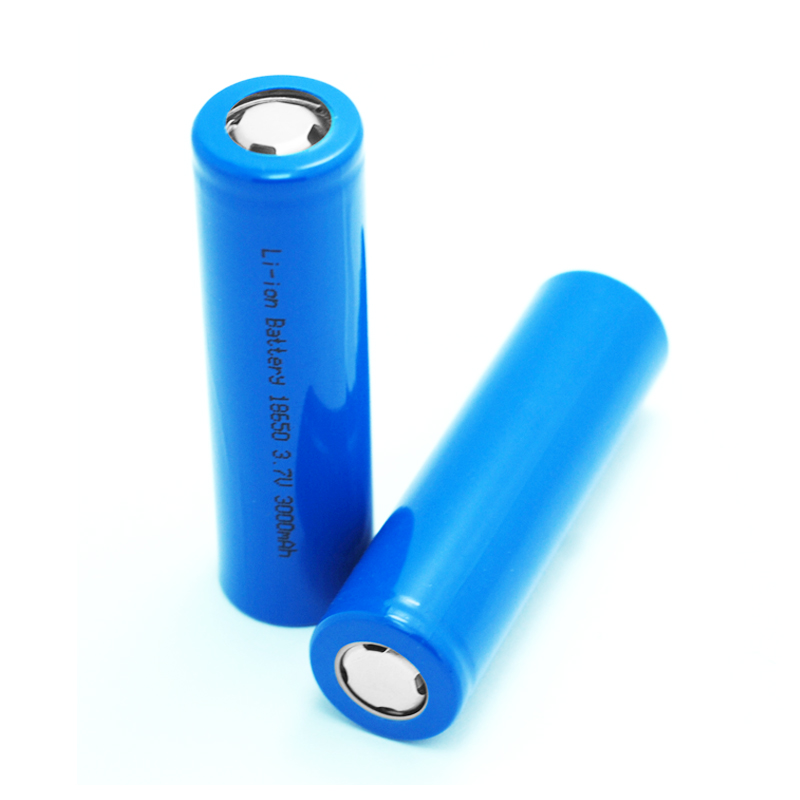
🔋 What Is the Internal Resistance of an 18650 Battery?
🧠 Summary
The internal resistance (IR) of an 18650 lithium-ion battery is a core electrical parameter that directly determines voltage sag, heat generation, power capability, and usable capacity under load. For most modern li-ion 18650 batteries, typical DC internal resistance ranges from 10 mΩ to 40 mΩ, depending on chemistry, design intent, and aging state. In real systems, IR matters more than nominal mAh.
⚙️ What Internal Resistance Actually Means (Not the Textbook Definition)
Internal resistance is the sum of electronic resistance, ionic resistance, and interfacial impedance inside an 18650 li-ion rechargeable battery.
🔌 In practice, IR controls:
-
Instant voltage drop under load
-
I²R heat generation
-
Maximum continuous and pulse current
-
Efficiency of a battery pack
👉 Conclusion: Two cells with identical capacity but different IR will behave like completely different batteries in the field.
📏 Typical Internal Resistance Values for Li-Ion 18650 Batteries
Measured at 1 kHz AC or via DC pulse methods, real-world values look like this:
Typical ranges:
-
High-drain 18650 cells: ~10–18 mΩ
-
Balanced energy/power cells: ~18–25 mΩ
-
High-capacity energy cells: ~25–40 mΩ
A 3.7 volt rechargeable battery 18650 with IR above ~50 mΩ is usually aged, low-quality, or unsuitable for load-bearing applications.
🔥 Why Internal Resistance Matters More Than Capacity
Capacity is a lab number. Internal resistance shows up immediately in the system.
⚡ Direct impacts:
-
Higher IR → larger voltage sag at startup
-
Higher IR → more heat at the same current
-
Higher IR → reduced usable capacity under load
-
Higher IR → earlier cutoff in BMS-protected packs
👉 Engineering reality: If your device resets under load, IR—not mAh—is the problem.
🧪 Factors That Determine Internal Resistance in an 18650 Battery
Internal resistance is engineered, not accidental.
🔬 Primary contributors:
-
Electrode thickness and porosity
-
Current collector design
-
Electrolyte conductivity
-
Separator impedance
-
Cell chemistry (IMR < NMC < ICR, typically)
Manufacturers intentionally trade IR vs energy density depending on the target market.
⏳ Internal Resistance vs Aging and Cycle Life
Internal resistance increases with time—even if capacity appears “normal.”
📉 IR rises due to:
-
SEI layer growth
-
Lithium plating from aggressive charging
-
Thermal stress
-
High-current operation near limits
Aged li-ion battery 18650 cells often fail on IR long before they fail on capacity.
🛠️ How Engineers Measure Internal Resistance (What Actually Works)
Forget cheap multimeter tricks.
🧰 Reliable methods include:
-
1 kHz AC impedance measurement
-
DC pulse load testing (ΔV / ΔI)
-
Manufacturer datasheet reference at 25°C
Measurements must be temperature-controlled. IR at 0°C can be 2–3× higher than at room temperature.
🧠 Engineer’s Selection Advice (Real-World Criteria)
From a system design perspective:
🔧 Selection rules:
-
Start with maximum continuous current, not capacity
-
Choose cells with 30% IR margin below calculated limits
-
Match cells by IR, not just voltage, in packs
-
Prioritize low IR for parallel configurations
👉 For high-load systems, low IR beats high mAh every time.
❌ Common Misconceptions About 18650 Internal Resistance
🚫 “Higher mAh always means better performance”
🚫 “All 18650 cells behave the same at 3.7V”
🚫 “IR doesn’t matter for short bursts”
🚫 “Aged cells are fine if they still charge to 4.2V”
These assumptions cause overheating, BMS trips, and early field failures.
❓ Frequently Asked Questions (FAQ)
🔹 What is a good internal resistance for an 18650 battery?
Below 25 mΩ for most applications; below 18 mΩ for high-drain systems.
🔹 Does internal resistance affect charging?
Yes. High IR increases charge heat and limits fast-charge capability.
🔹 Can internal resistance be reduced?
No. It only increases with age and usage.
🔹 Is internal resistance the same as impedance?
No. IR is typically a DC value; impedance varies with frequency.
🔹 Why do battery packs fail even with “good” cells?
Because unmatched IR causes uneven current sharing and thermal runaway risk.
📢 Call to Action (CTA)
We help engineers select low-IR, application-matched li-ion 18650 batteries with verified electrical data. Contact us to discuss your load profile and thermal limits.
Related Articles
What does discharge rate mean for 18650 batteries?