
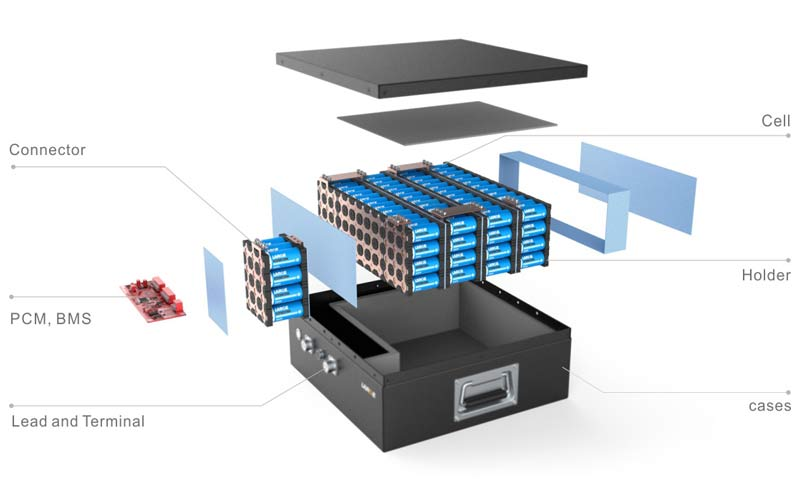
How to Customize Battery Pack
1.Confirm Battery Type
1.1 Lithium Battery:
- –Lithium Polymer (LiPo)
- Lithium Ion
–Cylindrical type
–Prismatic type
1.2 LiFePO4 Battery:
–Cylindrical type
–Prismatic type
1.3 NiMh Battery
1.4 NiCd Battery
1.5 Disposable Battery
2. Confirm Voltage and Capacity Requirements
-
Voltage = Number of cells in series
(for example, 6 cells × 3.7V = 22.2V pack) -
Capacity (mAh) = Number of cells in parallel
(Higher parallel count increases runtime)
3. Choose Cell Size and Type
Common cylindrical cell sizes include: 18650. 21700, 18500, 14650, 14500 and more.
Common NiMH/NiCd cell sizes include: AA, Sub-C, C, D, F and more
Select based on:
-
Size constraint
-
Energy requirement
-
Discharge current needs
4. Determine Pack Configuration
-
Series (S) for voltage
-
Parallel (P) for capacity
-
Configurations like 3S2P, 5S1P to meet dimension demand.
For example: A 22.2V 6000mAh pack might use 12 pieces of 3.7v 18650 3000mAh cells (6 pieces of cell in series, 2 pieces of cell in parallel).
5. Select a Suitable Connector
Depending on your device or application, choose:
Molex, JST, Tamiya, Anderson, or custom-designed connectors
6. Add Protection and Monitoring Features
Consider integrating:
-
PTC resettable fuses
-
NTC thermistors for temperature monitoring
-
PCB or PCM (if needed for safety compliance)
7. Choose a durable battery case
Encasing your pack in heat-shrink tubing, plastic cases, or custom housings protects the cells and extends lifespan.
Need to customize a battery pack? feel free to contact us
Reviews
There are no reviews yet.